
Flora’s Embrace on Growth, Change, and Their First Live Show
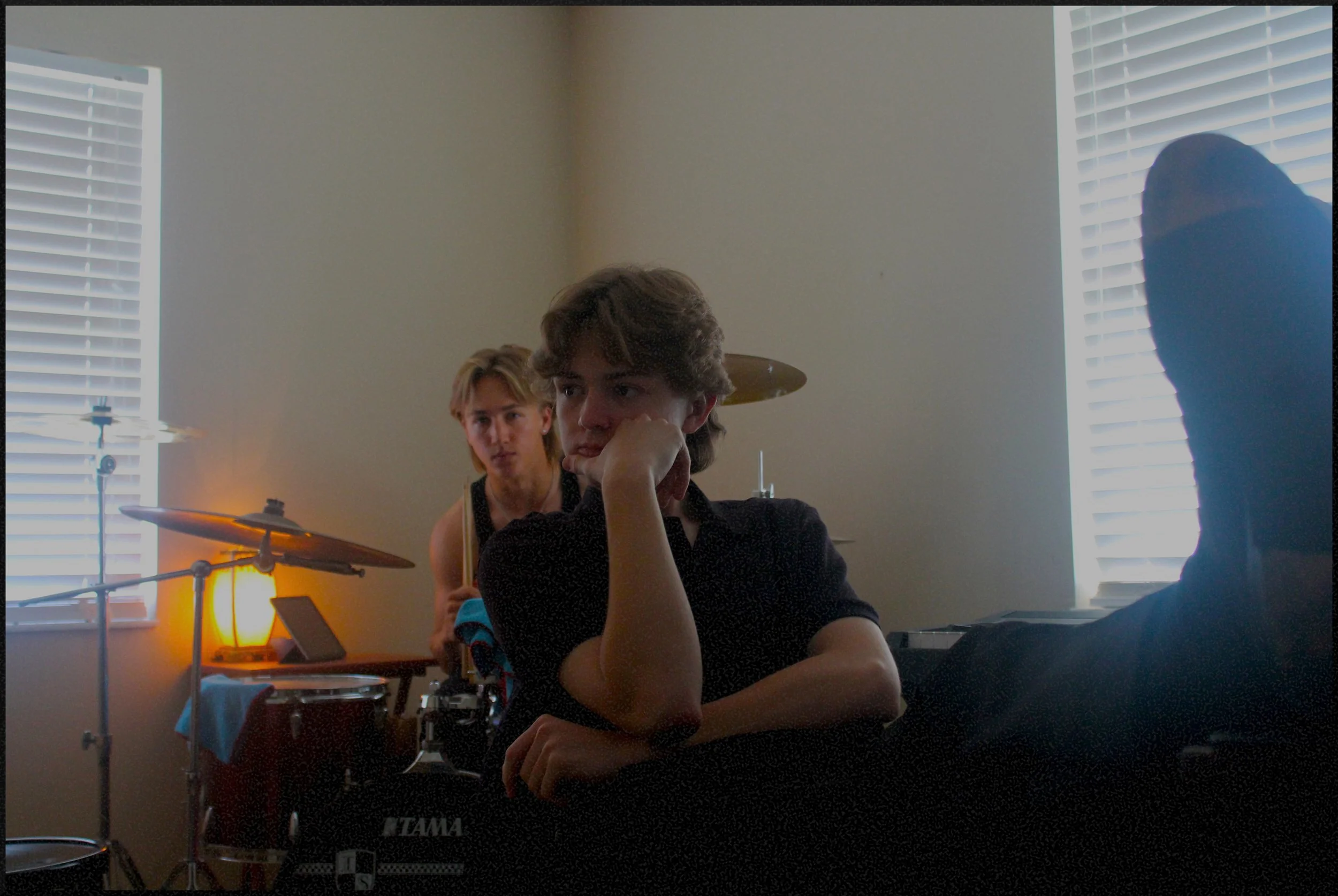
From best friends in middle school to releasing their debut album in high school and now preparing for their first live show, we sat down with Flora’s Embrace– an up-and-coming indie rock and alternative band- to get to know them and their music more. Ryan Oldham and Easton Workman have been producing music for over three years now, and we discussed their processes, integrating life, and imagery throughout this interview.
Not On Stage: Having seen you both start making music back in high school, what’s something about your sound or songwriting that you feel has matured the most, and is there anything from those early days that you’ve intentionally held onto in Flora’s Embrace?
Ryan: As we progressed in making music, and I as a songwriter, too, I feel like our early music has been rooted in more masking what the music's about. And especially the first album released when we were in high school, it felt a little more grounded in a way. But as I get older, I feel like just expressing myself as an art form, I feel more comfortable pouring in more of my just more myself into the music and being more transparent about what we're trying to come across. A big thing when we started was that we were writing music since early, early high school, like freshman or sophomore year, we never released anything. And a main thing for us, especially after we released that first record, was innovation. We always wanted to change, and anywhere that inspires us in anything, music, any sound, just everyday life, it doesn't matter. You don't have to stick to what you're doing. Whatever you feel like is actually going to move you forward, you can move that. So we're not afraid to change and maybe push the boundaries of what we've done before and broaden our horizons in a way. And that's something from early on we've always wanted to do. It's just experimenting and trying new things because that's what keeps it exciting.
Not On Stage: When did you guys decide that making music was something you were interested in, and did you take any inspiration from our small town in your work, whether it was a class or just life?
Ryan: We were always interested in making music. I feel like back when you're a kid, it seems more like a... almost like a fantasy in a way where it's like, Oh, we love doing this. But really, when we got into high school, and we decided we wanted to be serious about this, we were around, was it 15 or 16? But that's mainly when we decided, okay, we want to do this. We feel like we have something we can grasp onto, wrangle, and put in a direction where maybe we can do something with. And as we progressed as musicians in creating music, that vision just got more tuned down. And by the time we released that first album, it became almost like an obsession of ours. We think we have something we can do, and we know we want to take it as far as we can. Immediately after we released that first record, we started working on the second one, literally a month later.
Easton: I think the hometown part, actually, to me, was a huge part of it because I remember when our first song came out. So what was it? Was it May? What, May first of our senior year? Something like that. And just going to school, and everyone was just like... They didn't even comment on it a lot. Give us a full descriptive detail or anything. They were just like, good job. I just thought that was cool. It motivated us to keep doing it. At my baseball practice, we actually had a baseball game before a baseball game in our senior year. The other team was taking infield, and I just heard our song playing, and I'm like, what is going on? And also they play a couple of our songs at my school here now for baseball
Not On Stage: Your music feels atmospheric and intimate, almost like it’s capturing a moment just after something meaningful has happened. When did you realize that Flora’s Embrace was less about big climaxes and more about emotional aftermath?
Ryan: I think emotion is what drives this whole thing. I mean, that's what drives people in general, is strong feelings that move you forward and things that will resonate with you. I've noticed that music like that just really resonates and can touch people. And it touches me in a way where I feel like it's a part of a feeling that we can take and morph into something. Eason has said this before about our music, almost like a time capsule, in a way of a certain moment or emotion that we're feeling, and you can take it, and it's like putting a bug in a jar, almost, and now put it on your shelf. It's like, I remember when I caught that, or I remember what I was feeling. I mean, strip away all the production and everything, the core of our song is still really what that feeling is.
Easton: Going along with the idea of emotional aftermath, I think that we're both 20 years old. So we're at a point in our lives where a lot of things are coming and going at a very constant pace. A lot of changes are happening. So a lot of these songs that we write are often in different parts of these emotional phases. So a lot of times, songs could be about getting into something newer, but a lot of songs could be about leaving something that's in the past. And since we're in such a rapid time in our lives, that emotional aftermath, that phrase makes a lot of sense with our music.
Not On Stage: Many of your tracks feel reflective, like journal entries set to music. When listeners connect deeply to your songs, does that change how personal you’re willing to be moving forward?
Ryan: I feel like it's almost opening in a way. If people can connect to something specific that happened to me or that I feel like I poured myself into, and people can relate to it and be like, I can understand that. That is motivating for me to be even more open and pour more of myself into our work, which I feel like, in the end, too, that's how people connect over shared experiences.
Not On Stage: Efflorescence and Sense the Petrichor both evoke natural imagery with blooming, rain, and growth after dryness. What draws you to those themes, and how intentional is that symbolism in your work?
Ryan: Throughout our second record specifically, there's kind of a narrative and a theme hidden in the lyrics and kind of imagery that some of the songs paint where there's almost in a metaphor kind of way where like a storm or rain or cloudy cloud can feel like a big change coming in your life and it can totally flip your like and growing up in florida like a hurricane comes it can totally flip a whole neighborhood upside down i feel like that's a perfect analogy for a big change that can like rattle you and it's all about just pushing through the storm and then learning to adapt after. And I feel like those themes in imagery really represent just the kind of places that we were at that point, and places that we are now, and places that we will be in the future.
Easton: Something that goes along with what I was saying earlier about, uh, but the emotional aftermath question. I mean, if you put the definitions of like efflorescence and petrichor side by side, there are different parts of the same cycle. So like, I don't know, like, I think, um, I mean, we could stay on the same path or stay with the same cycle, maybe with future albums and stuff, but the ideas of cycles and changes happening all the time are easy to put imagery to and to create a visual for.
Ryan: If you want to talk about the definition, I actually have this in my wallet. You're not gonna be able to see this, but I was in art class in high school, and we were cutting up like a dictionary, and it's, this is the, this definition of efflorescence, which is one, which is the action or process of developing. And specifically that time, a couple of years ago, I mean, there's a lot of change, a lot of development that, you know, everyone at that point goes through.
Not On Stage: Your sound blends ambient textures, indie rock, and melodic pop elements. When you’re building a track together, what usually leads the process: a lyrical concept, a guitar progression, a rhythmic idea, or production atmosphere?
Easton: He'll just have these like core progressions or, you know, stuff like that, like a rhythm or something. And I think a lot of the time, they usually, for some reason, at least for the past two albums, don't really change too much. Usually, with whatever comes out of us right when it's made, he'll make a progression, and I'll add drums to it. Usually, what comes out of us, that is the core of the song until it is done. A lot of artists, when they make something, they'll be like, I think we should speed it up, slow it down, change it up completely. We hold more of an emotional attachment to whatever is coming out of us at that moment. So, I mean, yeah, the core of all of our songs is usually made instantly. And then, you know, over time, we build everything around it.
Ryan: You know, you're messing around on the computer and we're producing, and we're coming up with a cool sound or something, and that'll take it. But really, that comes with a lot of the weight of, especially some of our more emotional songs. It comes from the original songwriting, and then you translate it into the production. Because if you don't have a good foundation, then things can fall apart.
Not On Stage: There’s a layered quality to your music that feels almost cinematic. Do you think visually when you write, imagining colors, places, or moods, or does that imagery emerge after the song is formed?
Ryan: I feel like it's full force on the song and seeing whatever that brings out. And it's honestly like a way, it's honestly like, you’re writing you're not even looking in the, like what's going to happen. It just, everything just comes out. It's not. And then whatever that finished product is, it's like, okay, that reminds me of this, and that can turn into this, really. So I feel like the music is definitely what drives all of the imagery and just kind of the vibe in general forward.
Easton: We'll have a melody or like the core of a song, and Ryan will send Vocal vomit or something like that. Vocal vomit, yeah. Vocal vomit, where it's just kind of like mumbo jumbo. Inside of that, he'll have phrases or words that will come out. And usually those phrases and words stick around because they're like coming out for a reason. Like, some words and phrases are on his mind at that point. So I think themes, the seeds of themes can be planted early in the process, but they really become a full visual and like imagery experience by the time the song is developed.
Not On Stage: Your songs often balance softness with tension. How do you decide when to let a track stay minimal and intimate versus when to let it expand and swell?
Ryan: It can feel like certain songs call for certain things. There’s a song on the album Square One and most of that song is pretty other than some parts it's pretty minimal and pretty focused because it wants to capture that specific vibe and then you realize it can get bigger later but there's also other songs we have that make that feel like they are meant to be huge, like Taking The Floor that need that big stage.
Easton: I think that there's a threshold when you start working on a song, and as you develop it, the song hits that threshold at some point, and you have to decide whether to go past the threshold and make it bigger or cut back a little bit and get more intimate. So I think it really shows when you do that, I think it helps with a progression, like looking at our songs almost like a storyline for a movie, or you know, a plot to something, to where it could either get to this point and go up or go down.
Not On Stage: The name Flora’s Embrace suggests openness, growth, and maybe even surrender. Does the project feel like an escape, a confrontation with reality, or a way of making peace with it?
Ryan: It feels like an escape from reality in a way. It feels like we can go and just step back from the whole world and focus on what we're trying to accomplish and do. And it feels really freeing. And I mean, the name Floras Embrance, it is about, there's a lot of stuff we talk about, which is a lot about tackling, just like change and embracing things in your life. So I feel like it's a way to step back and look at something objectively in a way, but still have that subjective feel to it, so it is freeing.
Easton: I think in my eyes and the way that I approach our music, I think it's actually for me, it's both because for some things, I mean a lot of things in life you have to get away with to come back to it. A lot of times when I do music, it helps me escape reality, but then I come back to reality more at peace with it.
Not On Stage: Looking ahead, do you see Flora’s Embrace continuing to explore atmospheric introspection, or are you interested in pushing toward something more experimental or sonically disruptive next?
Ryan: We're always trying to change, and whatever feels exciting is where the direction we're going to go. I don't think we really have a goal of I want this other than, you know, like, but this is the direction we're going to go. It's like, why? My question is, why? Why don't you just take things in any direction and create something cool and unique out of it? So I think we would definitely experiment with that.
Easton: I think we often don’t take the music in the direction that we want to go but the music often takes us in the direction it wants to go like it really whatever comes out of us is what we go along with because I mean if what you're making subconsciously you turn your brain off and start playing whatever comes out is usually what your heart wants to make so we pursue whatever comes out of us so that can be I mean that could be something completely different from what we made last year or it could be something along the same lines I mean it could be anything.
